
Digitizing the Last Mile: A New Era for Zambia’s Health Supply Chain
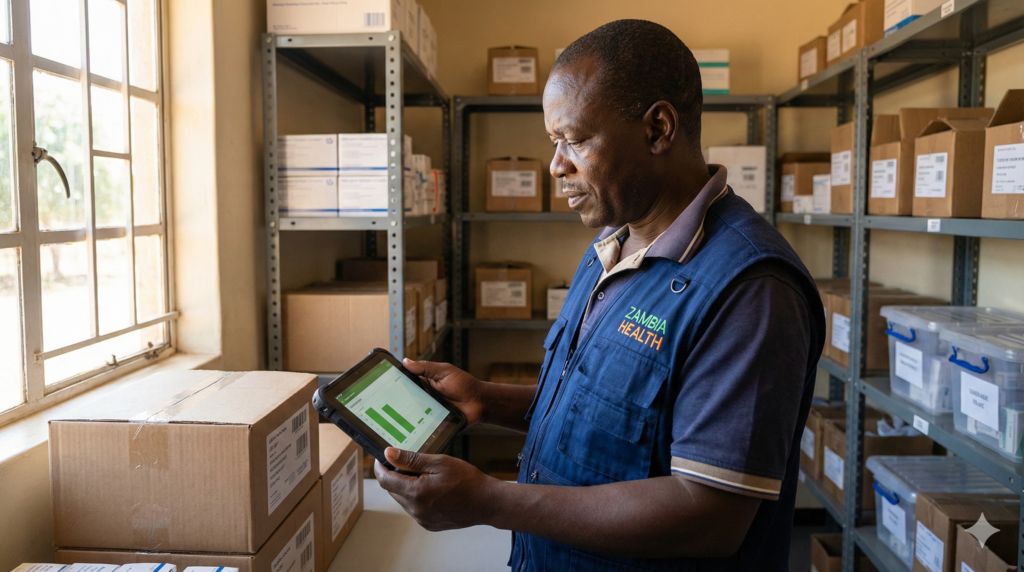
Project Profile: USAID eSCMIS
1. Project Data (Sidebar/Header)
- Full Title: USAID Electronic Supply Chain Management Information System (eSCMIS)
- Donor: USAID | PEPFAR
- Role: Prime Contractor (Coalition Health Zambia)
- Duration: January 2020 – January 2025
- Geography: National Scale (Covering all 10 Provinces)
- Target: Ministry of Health (MOH) and Zambia Medicines and Medical Supplies Agency (ZAMMSA)
2. Overall Objective
The primary mandate of the USAID eSCMIS project is to ensure an uninterrupted supply of life-saving medicines to the people of Zambia. We achieve this by transforming the national health supply chain from an outdated paper-based system into a modern, digital, and data-driven network.
For years, the Zambian supply chain suffered from a lack of visibility. Central decision makers could not see what was happening at the “Last Mile,” the rural clinics where patients seek care. This disconnected system led to stockouts of critical HIV and malaria medicines in some areas, while other areas had surpluses that went to waste. Our objective is to close this gap, ensuring that the right commodity is in the right place at the right time.
3. The Strategy: Digital Transformation & Sovereignty
Our strategy is not just about installing software. It is about National Systems Strengthening. We view technology as an enabler for better governance.
By deploying the Electronic Logistics Management Information System (eLMIS), we provide the Ministry of Health with a “Control Tower” view of the entire country. However, our ultimate strategic goal is Sustainability. We are building a system designed to be owned, managed, and upgraded entirely by the Government of the Republic of Zambia (GRZ) without indefinite reliance on donor support.
4. Key Activities & Implementation Pillars
A. Infrastructure & Technology
We managed the largest digital health deployment in the region. This involved upgrading the physical and digital infrastructure of the public health sector.
- eLMIS Deployment: We transitioned over 2,900 health facilities from paper ledgers to the eLMIS Facility Edition (FE). This software automates ordering, tracks consumption, and predicts future needs based on real usage data.
- Resilient Connectivity: Understanding the challenges of rural Zambia, we deployed hybrid solutions. We installed solar power backups and offline-capable devices to ensure that clinics in off-grid areas could still manage their inventory and sync data once connectivity was restored.
- Central Architecture: We upgraded the central servers at the Ministry of Health to handle the massive traffic of national health data, ensuring speed, security, and redundancy.
B. Capacity Building (The Human Element)
A computer system is only as good as the person using it. We executed a massive change management campaign.
- Training Network: We trained thousands of pharmacists, facility in-charges, and district health officers. We moved beyond simple classroom training to a “mentorship model” where technical supervisors visit facilities to troubleshoot issues on site.
- Super User Group: To ensure sustainability, we identified and trained a cadre of “Super Users” within the Ministry of Health. These government employees are now capable of fixing software bugs, resetting passwords, and training new staff, effectively replacing the need for external IT consultants.
C. Governance & Transition
As the Prime Contractor, CHZ is responsible for the responsible handover of this massive investment.
- Code Ownership: We are currently in the final stages of transferring full ownership of the source code and server administrative rights to the Ministry of Health.
- Data Use Culture: We work with District and Provincial Health Offices to establish “Data Review Meetings.” In these sessions, government managers use the eLMIS dashboards to make budget decisions, shifting the culture from “reporting for donors” to “using data for management.”
5. Key Outcomes (The Impact)
- 99% Reporting Rate: We achieved near-perfect reporting consistency across the network. This means the Ministry of Health now has total, real-time visibility into national stock levels, eliminating the “blind spots” that previously caused stockouts.
- Wastage Reduction: By digitally tracking expiry dates (FEFO – First Expiry, First Out), the system automatically flags products that are about to expire. These commodities can then be redistributed to facilities with higher consumption, saving the government millions of dollars in potential drug wastage.
- Commodity Security: The improved visibility has stabilized the supply of Antiretrovirals (ARVs) and Essential Medicines. Patients can now rely on their local clinic to have their medication in stock, improving adherence to treatment and overall health outcomes.
6. The Overall Impact
“The USAID eSCMIS project proves that sophisticated digital solutions can thrive in resource-constrained environments. By modernizing the logistics backbone of the health sector, CHZ has helped build a resilient supply chain that safeguards the health of every Zambian family. We are not just delivering data; we are delivering the promise that medicine will be there when it is needed most.”